
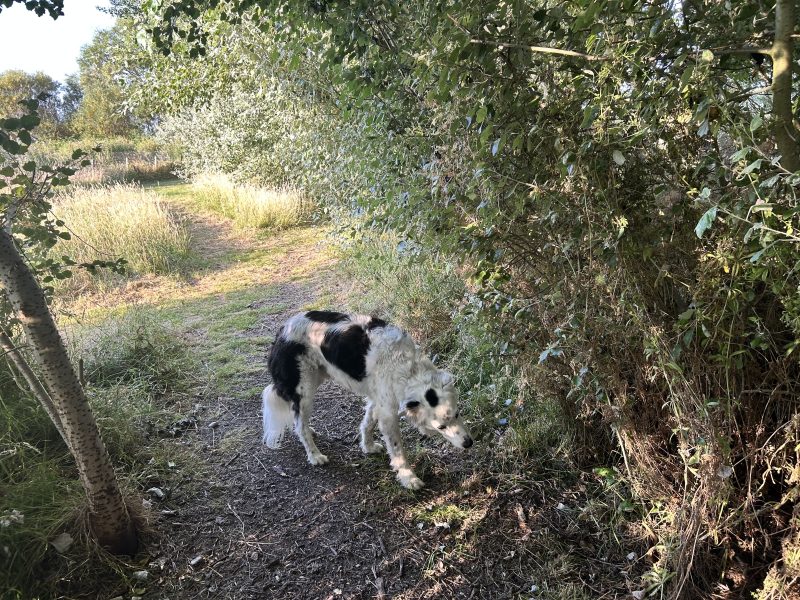
You’ve left the house with your dog, planned a decent walk and perhaps even imagined returning home before the kettle has completely forgotten about you.
Then your dog finds a particularly interesting patch of grass.
They sniff it from one direction, approach it from another, investigate the neighbouring lamppost and then return to the original patch just in case a major development has taken place during the last thirty seconds.
It can be tempting to hurry them along. After all, we tend to measure a walk by distance, time or how many steps our watch tells us we’ve completed. However, our dogs experience that same walk very differently.
For them, sniffing isn’t something that gets in the way of the walk.
Sniffing is a huge part of the walk.
Dogs experience the world through scent
Humans tend to rely heavily on what we can see. We look at the path ahead, notice the people approaching and perhaps admire the view when we remember to look up from our phones.
Dogs gather a remarkable amount of information through their noses. Smell helps them explore their surroundings, recognise individuals, investigate food, make decisions and learn about what has happened in an area.
When your dog stops to examine a tree, they aren’t necessarily wasting time or being difficult. They may be discovering which dogs have visited, how recently they passed through and all sorts of other information that remains completely unavailable to the human at the other end of the lead.
We see a tree.
Our dogs find the local noticeboard, news feed and neighbourhood gossip column.
Sniffing is a natural behaviour
Dogs don’t need to be taught how to sniff. It’s a natural, species typical behaviour and an important part of how they interact with their environment.
That doesn’t mean every dog will sniff in exactly the same way. Breed, age, health, confidence, previous experience and the environment can all influence how a dog uses their nose.
Some dogs move slowly and investigate every individual blade of grass. Others gather information quickly before moving on. A nervous dog might sniff as part of carefully exploring an unfamiliar place, while an experienced scentwork dog may search with much more obvious purpose.
There isn’t one correct way for a dog to use their nose. The important thing is giving them suitable opportunities to do it.
Sniffing provides mental enrichment
A walk doesn’t need to be physically exhausting to be worthwhile.
When dogs sniff, they’re receiving and processing information. They may be following a scent trail, comparing smells, deciding where to investigate next or working out where another animal has travelled.
This gives the brain something meaningful to do. It encourages curiosity, decision making and problem solving rather than simply asking the dog to walk at our pace from one end of a route to the other.
Sniffing shouldn’t be treated as a direct replacement for every other form of exercise, interaction or enrichment. Dogs still have individual physical, emotional and social needs. However, opportunities to use their noses can make walks and everyday activities far richer.
A shorter walk with time to investigate may sometimes offer your dog more than a longer walk spent being hurried away from everything that interests them.
Sniffing gives dogs choices
Much of a dog’s day is controlled by humans. We decide when they eat, where they sleep, when they go outside and which route they take.
Allowing a dog to choose where to sniff may seem like a small thing, but small choices matter.
Choice gives dogs a degree of control over their experiences. On a suitable walk, we can occasionally follow their nose rather than expecting them to follow our route. They can decide which direction deserves further investigation, where they would like to pause and when they have gathered enough information to move on.
Naturally, this still needs to be safe. I’m not suggesting we allow a determined Spaniel to guide us across a busy road because something interesting once touched a hedge on the other side.
However, where the environment allows it, giving dogs more freedom to explore can make walks feel less like an instruction and more like a shared experience.
Sniffing can support confidence
For some dogs, the outside world can feel overwhelming. Traffic, unfamiliar people, dogs, noises and new environments may all place demands on them.
Carefully arranged opportunities to sniff can allow a dog to explore without being pressured into direct interaction. Instead of asking them to approach something frightening, we can give them time, space and a familiar natural behaviour.
This doesn’t mean sniffing will magically remove fear or resolve reactivity. If a dog is worried, their safety, distance from triggers and individual support still matter. Some dogs may also become too concerned to sniff at all, which can be useful information about how they’re feeling.
However, well planned sniffing and scentwork activities can create achievable experiences in which dogs make choices, solve problems and discover that they can succeed.
Confidence grows through feeling safe and capable, not through being pushed into situations before a dog is ready.
Sniffing helps us understand our dogs
Watching a dog use their nose can teach us a great deal.
We begin to notice how they approach new environments, how quickly they search and what happens to their body when they find an interesting scent. We can see when they’re confident, when they need more time and when the environment might be becoming too difficult.
Scentwork develops this observation even further. The dog has access to information that we don’t, so we have to learn to watch and trust them.
That change is important. In much of dog training, we give the dog a cue and look for a response. During scentwork, the dog often knows far more about the problem than we do.
Our role becomes less about directing every move and more about listening to what the dog is telling us.
For humans, keeping quiet and allowing the dog to solve the problem can require considerable training. Fortunately, most dogs are very patient with us.
Should dogs be allowed to sniff on every walk?
Dogs should have regular opportunities to sniff, but every walk and every environment will be different.
There will be moments when you need to keep moving for safety or practical reasons. Your dog may also enjoy other types of walks involving play, training, exploring or travelling somewhere together.
The aim isn’t to stand beside every lamppost until the seasons change. It’s to recognise that sniffing has genuine value and build some unhurried exploration into your dog’s life.
You might try:
- Allowing your dog to choose the direction of part of the walk
- Visiting quieter places where they have more time to explore
- Using a suitable longer lead where it’s safe
- Pausing instead of automatically pulling them away from a smell
- Scattering food in grass for them to locate
- Hiding food or toys around the home or garden
- Letting your dog investigate safe new objects
- Trying simple scentwork searches
- Joining a positive scentwork class
Even a few changes can turn an ordinary walk into a more interesting experience for your dog.
Sniffing and loose lead walking
People sometimes worry that allowing sniffing will ruin their dog’s loose lead walking. Actually, sniffing can become part of the reward for walking on a relaxed lead.
If your dog wants to investigate a safe smell, you can wait for the lead to relax or for a moment of connection before moving towards it together. Your dog learns that staying connected with you provides access to the environment rather than removing all the interesting parts.
Loose lead walking doesn’t need to mean marching beside your leg and ignoring the world. It can mean learning how to move together, communicate and enjoy the same walk, even if you’re each noticing very different things.
From sniffing to scentwork
Sniffing happens naturally during walks, but scentwork develops that ability into a shared activity.
In scentwork, dogs learn to search for a particular item, food or target odour. Search areas can include containers, rooms, outdoor environments, vehicles, objects, straw bales and natural spaces.
The dog gets to use their strongest sense while the human learns how scent moves, how their dog searches and what changes in the dog’s body language might indicate that they’re close to the source.
Scentwork can be adapted for puppies, adolescent dogs, senior dogs and dogs who need additional space. It can be enjoyed purely for fun or developed into increasingly challenging searches as the partnership gains experience.
At SkellyWAGS School of Scent, we aren’t interested in making every dog search in exactly the same way. We want dogs to become confident problem solvers and guardians to discover the joy of watching, understanding and trusting them.
You can learn more about our scentwork classes, workshops and 1-1 scent training in Kent at Waggy Tails Field in Old Romney.
Let them sniff
The next time your dog stops to investigate a smell, try looking at the moment from their point of view.
You might see a damp hedge, a patch of grass or a slightly questionable lamppost. Your dog may be discovering who passed through, where they went and what they had for breakfast.
We don’t need to understand everything they find fascinating. Sometimes we simply need to give them time to find it fascinating.
Let them sniff. It’s their walk too.

For some dogs, a class environment may not always be ideal and can be stressful. Our 1-2-1 dog training sessions Read more

A great way to have fun with your dog and train at the same time. Hoopers is a form of Read more

At SkellyWags we think it is an amazing way to work on teamwork between your dog and you. It is Read more

Here at SkellyWags you may have noticed we put a lot of energy into telling anybody that will listen about Read more