
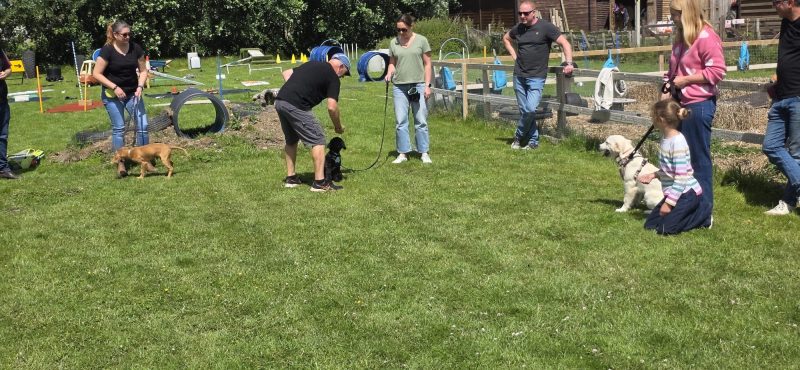
As dog trainers, we spend a great deal of time learning how dogs learn. We talk about reinforcement, association, motivation, timing, environment and whether the piece of cheese in our hand is actually more interesting than the spaniel disappearing into the undergrowth.
All very important stuff.
However, there is another animal standing at the end of the lead and I don’t mean the dog, it is the human.
If we want training to work outside the class, we need to help the guardian understand what they are doing, why they are doing it and how to do it again when the trainer is no longer standing beside them nodding encouragingly.
This is where VARK not BARK comes in.
What is VARK?
VARK is a simple way of thinking about how information can be presented. The letters stand for:
- Visual – seeing something demonstrated through pictures, diagrams, videos or a live example.
- Auditory – hearing an explanation and talking the idea through.
- Reading and writing – using written instructions, notes, handouts or step-by-step guides.
- Kinaesthetic – learning by getting involved and physically practising the skill.
It is worth saying that people cannot be divided neatly into four boxes. Most of us learn through a mixture of these methods, and our preferences can change depending on the subject, the situation and how possibly much coffee we have consumed!
VARK is best used as a reminder to teach in different ways, rather than as a label stuck permanently on someone’s forehead.
Explaining it once doesn’t mean it has been learned
One of the easiest traps for a trainer to fall into is believing that because we have explained something clearly, the other person must now understand it.
We may have delivered a truly magnificent explanation of reinforcement placement. In our heads, it was clear, concise and possibly worthy of its own educational documentary.
Meanwhile, the guardian is still holding the lead, the treats, a clicker and a poo bag, while their puppy attempts to eat the lead. They heard the first sentence and have been improvising ever since.
That isn’t a failure on their part. It simply means we may need to present the information differently.
They might need to see us demonstrate it. They may need a short written reminder to read later at home. Most importantly, they need an opportunity to try it themselves without feeling they are being watched by the judging panel of Strictly Come Dog Training.
A good dog training lesson should use all of VARK
Imagine we are teaching loose lead walking.
We could begin by briefly explaining what we are aiming for and why pulling happens. That gives the auditory learner some useful context.
We can then demonstrate the exercise so the guardian can visually see the timing, movement and reward placement. This is often far clearer than saying, “Reward by your left leg,” six times while pointing at various parts of our trousers.
Next, the guardian has a go. This is the kinaesthetic part: holding the lead, moving, rewarding and finding their own rhythm. Knowing the theory and doing it while attached to an enthusiastic Labrador are two very different qualifications.
Finally, we can provide a short written guide or recap so they do not have to remember every word after the session. Dog training classes can contain a lot of information, especially when somebody’s puppy has spent most of the lesson stealing cones.
The same principle applies to recall, scentwork, cooperative care, puppy training and almost everything else we teach. Explain it, show it, let people try it and give them something helpful to revisit afterwards.
The human may be overwhelmed too
We are becoming much better at recognising when dogs are overwhelmed. We notice when the environment is too busy, when the task is too difficult or when the dog needs more distance and fewer demands.
We need to offer humans the same consideration.
A guardian may be worried about getting things wrong. They may have received conflicting advice from ten different people, three television programmes and someone in the park whose Collie apparently trained itself. They may struggle to take in verbal instructions while also watching their dog. They may simply need a moment to process what has been said.
If someone doesn’t understand an exercise, repeating the same explanation more loudly is unlikely to unlock the mystery. A demonstration, an analogy, a diagram or allowing them to practise one small part may make everything click.
That is not lowering the standard. It is good teaching.
Train the human in front of you
We often say that we should train the dog in front of us. We look at what that individual dog needs rather than forcing every dog through exactly the same process. Surely we should do the same for the person standing beside them.
Some guardians want to understand the science. Some need a simple starting point without an entire lecture on learning theory. Some will remember a demonstration immediately, while others will go home, read the notes and suddenly have their lightbulb moment over a cup of tea.
Our job is not to show everyone how much we know. It is to help them leave knowing what they can do next.
That may mean changing our words, slowing things down, breaking an exercise into smaller parts or admitting that our first explanation did not land. A good trainer doesn’t blame the learner when communication fails. We tweak the teaching.
That sounds rather familiar, doesn’t it?
Better teaching builds better relationships
When guardians understand what they are doing, they become more confident. When they feel confident, their timing often improves, practice becomes easier and training feels less like a weekly test they forgot to revise for.
Most importantly, they are better able to understand and support their dog.
Dog training is not really about transferring a set of instructions from the trainer to the guardian and then down the lead to the dog. It is about helping two different species communicate, learn and live together. The trainer’s role is to make that information accessible to both ends of the lead.
So yes, dog trainers absolutely need to understand BARK or at least what the barking might be communicating.
But we need to understand VARK as well.
Because if the dog is learning but the human is completely lost, we haven’t really taught the team.
And no, repeating “mark and reward” for the seventeenth time while waving a cocktail sausage does not automatically count as a different teaching method.
Looking for supportive, dog centred training?
At SkellyWAGS, training is tailored to the dog and the person standing beside them. We explain, demonstrate, practise and adapt, because progress is not about everyone doing things in exactly the same way. It is about helping each dog-and-human team find what works for them.
Take a look at our classes and 1-2-1 training, or get in touch for a friendly chat about the support that would suit you and your dog.

For some dogs, a class environment may not always be ideal and can be stressful. Our 1-2-1 dog training sessions Read more

A great way to have fun with your dog and train at the same time. Hoopers is a form of Read more

At SkellyWags we think it is an amazing way to work on teamwork between your dog and you. It is Read more

Here at SkellyWags you may have noticed we put a lot of energy into telling anybody that will listen about Read more