
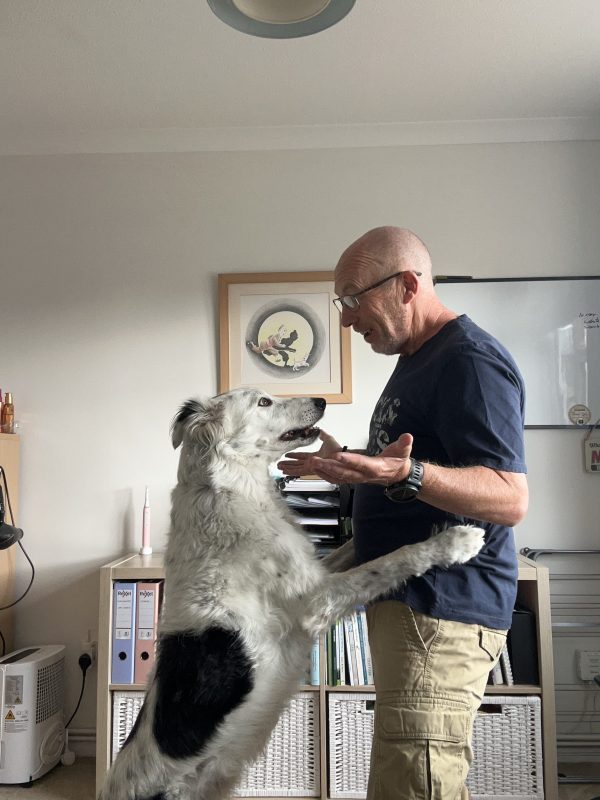
If your dog launches themselves at visitors, scrambles at your clothes or bounces up when you walk through the door, it can feel as though they’re being rude on purpose. You might even wonder whether they’re testing you.
However, most jumping isn’t “naughty” in the way we tend to mean it. It’s usually a normal dog behaviour that has worked for them before, or a response to excitement, uncertainty or other big feelings.
The good news is that once we understand what the dog is trying to achieve, we can respond in a way that’s kinder, clearer and far more effective.
Is jumping up really “bad behaviour”?
Jumping up isn’t “bad behaviour” in a moral sense, although it can certainly become difficult or unsafe particularly around children, older people or anyone who may be unsteady on their feet.
Dogs don’t arrive knowing that humans prefer greetings to happen with four paws on the floor. That’s one of our rules, not something they have deliberately chosen to ignore.
Many dogs naturally want to get closer to our faces, hands and pockets. They may also have learnt that jumping results in eye contact, talking, touching or laughter. Even being told “No, get down!” can be rewarding if the dog is looking for interaction.
Rather than asking, “Why is my dog being naughty?”, it’s much more helpful to ask:
“What is my dog getting from this behaviour?”
That small change of question can make a very big difference.
Why do dogs jump up?
Dogs jump for many different reasons. Sometimes there’s one obvious explanation, but often it’s a mixture that changes depending on the situation, environment and person in front of them.
1) They’re excited and trying to get closer
For many dogs, jumping is simply an overflow of happy energy. They’ve been waiting, they’ve missed you or somebody interesting has arrived.
Their paws have left the floor before their brain has had time to submit the relevant paperwork.
The dog isn’t trying to take charge. They’re simply very pleased, very excited and currently lacking a more suitable way to express it.
2) They’ve learnt that jumping works
Dogs repeat behaviours that bring worthwhile results.
If jumping has previously led to fuss, eye contact, laughter, food or somebody talking to them, the behaviour has been reinforced, even if that wasn’t our intention.
This can also explain why a dog jumps at some people but not others. If Uncle Dave always laughs, waves his hands and makes an enormous fuss, your dog may quite reasonably conclude that Uncle Dave enjoys being greeted at head height.
3) They want access to hands, food or pockets
Human hands deliver treats, leads, toys and affection, so it isn’t surprising that dogs take an interest in them.
Some dogs jump because it brings them closer to the good stuff, particularly if treats have often appeared from a pocket or been handed down from a standing position.
4) They’re seeking reassurance or attention
Not all jumping is joyful.
Some dogs jump when they feel uncertain, overwhelmed or in need of reassurance. They might paw, lick, wriggle or repeatedly attempt to make contact.
In these situations, simply ignoring the dog may not address what they’re feeling. We need to look at the whole picture, including their body language, the environment and whether they’re genuinely comfortable with the interaction.
5) They’re struggling to regulate themselves
A dog who needs more appropriate physical activity, mental enrichment or opportunities to sniff and decompress may find exciting situations harder to manage.
Equally, a tired or overstimulated dog can appear even more frantic. Sometimes the answer isn’t another long walk or an attempt to “wear them out”. It might be more rest, more sniffing, a predictable routine or fewer overwhelming experiences.
This is why it’s so important to train the dog in front of you rather than reaching for one fixed answer.
Why telling a dog off can make jumping worse
It’s tempting to push a dog away or firmly tell them to get down. The trouble is that many dogs experience this as attention, and attention may be exactly what they wanted.
Pushing can become a rather exciting wrestling game. Reaching for the collar can create worry or conflict, and shouting may increase arousal when the dog is already struggling to cope.
Adding more intensity to an already intense greeting rarely makes things easier.
Punishment might stop the behaviour in that moment, but it doesn’t teach the dog what to do instead. It can also change how the dog feels about visitors, greetings or the person delivering the correction.
The aim shouldn’t be to win a battle. It should be to help the dog learn a safer, more manageable way to say hello.
What should your dog do instead?
Before trying to stop jumping, decide what you would like your dog to do.
Your chosen greeting behaviour might be:
- Keeping four paws on the floor.
- Offering a sit.
- Going to a mat or safe space.
- Finding scattered food.
- Collecting and carrying a toy.
- Approaching when they’re ready rather than immediately greeting.
A sit can be useful for some dogs, but it isn’t automatically the right answer for every dog. A bouncy adolescent may initially find four paws on the floor much easier, while a worried dog may need space rather than being asked to sit close to a visitor.
Choose an alternative that suits your dog, your home and the situation.
A practical plan for reducing jumping up
Step 1: Practise before you need it
Training is much easier when the front door isn’t open and three excited relatives aren’t standing in the hallway.
Start in a quiet environment and practise small parts of the greeting. You might:
- Approach your dog and reward four paws on the floor.
- Touch the door handle and reward them for remaining where they are.
- Open the door slightly, close it and reward manageable behaviour.
- Put on your coat or pick up your keys without immediately leaving.
- Practise going to a mat or searching for scattered treats.
Build things gradually. If your dog starts jumping or becomes unable to respond, the exercise may simply be too difficult at that moment. Make it easier and try again.
That isn’t failure, it’s useful information.
Step 2: Try not to let jumping become the route to attention
When your dog jumps, stay as calm and neutral as you reasonably can. Avoid pushing, grabbing, waving your hands or repeatedly telling them off.
You might turn your body slightly away or create a little space. Then be ready to reconnect and reward as soon as they offer something more manageable, even if that’s only a brief moment with four paws on the floor.
For dogs who become worried or frustrated when attention disappears, completely ignoring them may not be the best approach. Instead, focus on helping them succeed through distance, food, movement or a predictable greeting routine.
Step 3: Reward the smallest successes
Don’t wait for perfection.
The instant your dog keeps their paws down, offers a sit, moves towards their mat or chooses not to launch, let them know that choice was worthwhile.
Depending on your dog, the reward might be:
- A treat delivered near the floor.
- A small scatter of food.
- Access to a favourite toy.
- Gentle affection.
- Moving away with you.
- Being allowed to greet the visitor.
Match the reward to the dog. The aim isn’t to remove all excitement or turn them into a furry ornament. It’s to help them express that excitement in a way everybody can cope with.
Progress might begin with one second of paws on the floor. That second is worth noticing.
Step 4: Manage the environment
If your dog practises jumping on every visitor, changing the behaviour will be much harder. Management prevents rehearsal and helps everybody stay safe while training takes place.
Useful options include:
- A baby gate so your dog can see visitors without immediately reaching them.
- A lightweight lead during supervised greetings, allowing you to create space without grabbing the collar. Never leave it attached while your dog is unattended.
- A treat pot near the door so rewards are available when you need them.
- A mat or safe area where your dog can settle without being approached.
- Asking visitors not to greet your dog until you say they’re ready.
- Giving your dog a chew or food activity in another room if visitors are too difficult.
Management isn’t cheating. Sometimes it’s the kindest and most sensible part of training.
What to do in common situations
When you come home
Arrivals can be a huge trigger, especially if your dog has been waiting for you.
Try entering quietly and give your dog a moment to process your return. Keep your hands away from your pockets and avoid immediately bending over them or turning the greeting into a full scale reunion concert.
Reward four paws on the floor, offer scattered food or encourage your dog to collect a toy. If they become overwhelmed, create a little space and try again when they’re more able to cope.
You don’t need to ignore them for several minutes or pretend you haven’t seen them. You’re simply helping them discover that keeping their paws down is the easiest way to get the connection they wanted.
When visitors arrive
Set your dog up before opening the door.
They might wait behind a baby gate, search for scattered treats, settle with a chew or remain on a supervised lead at a comfortable distance. Ask visitors to enter without calling the dog, leaning over them or immediately reaching towards their head.
If your dog is ready, allow them to approach in their own time. Greetings can pause if jumping begins and restart when their paws return to the floor.
Some dogs may not want to greet visitors at all, and that’s okay too. Being in the same room doesn’t mean they have to interact.
When your dog jumps at people on walks
Jumping on walks is often connected to excitement, frustration or being too close to somebody before the dog is ready.
Create more distance and reward your dog for noticing the person without rushing towards them. You could then use an easy, familiar behaviour such as hand touch, finding food or moving away with you.
It’s also perfectly acceptable to stop on lead greetings for a while. Your dog doesn’t need to meet everybody they see, and “Sorry, we’re training” is a complete sentence.
What not to do
Avoid methods that rely on pain, fear or intimidation, even if somebody promises they’ll produce a quick result.
- Don’t knee your dog in the chest.
- Don’t stamp on their feet.
- Don’t push them away or turn it into a physical battle.
- Don’t grab or yank their collar.
- Don’t shout or use equipment designed to punish.
- Don’t expect them to sit while people continue squealing, waving and exciting them.
These approaches don’t teach a safe greeting. They may suppress the behaviour temporarily, increase arousal or create worry around people.
Clear boundaries matter, but boundaries don’t need intimidation.
Remember: excitement isn’t the enemy
Your dog doesn’t have to greet visitors like a hotel receptionist.
A greeting can still include a wagging tail, a wriggly bottom and genuine enthusiasm. We’re not trying to remove their personality or stop them being pleased to see people.
We’re helping them find a way to express that excitement without somebody ending up wearing the dog as a hat.
Progress, not perfection.
When jumping might mean something else
Most jumping can be helped through thoughtful management and training. However, extra support may be worthwhile if:
- Jumping is accompanied by snapping, growling or frantic behaviour.
- Your dog appears frightened or distressed during greetings.
- They struggle to settle anywhere in the house, even when their needs have been met.
- The behaviour appears suddenly in an adult dog.
- Jumping is accompanied by other noticeable physical or behavioural changes.
Sudden changes should always be discussed with your vet so that pain, discomfort or an underlying medical issue can be ruled out.
A qualified, ethical, reward-based trainer or behaviour professional can then help you understand what’s driving the behaviour and create a plan for the individual dog.
Your dog isn’t being naughty, they’re communicating
Dogs jump because the behaviour has worked before, because they’re excited or because they’re finding the situation difficult.
They don’t need to be dominated, corrected or shown who’s boss. They need us to understand what’s driving the behaviour and teach them something they can realistically do instead.
That might be a sit, four paws on the floor, finding food, collecting a toy or having a little more space. The right answer will depend on the dog in front of you.
With patience, sensible management and plenty of reinforcement for the choices we want to see, dogs can learn safer ways to greet people without losing the joy of saying hello.
Frequently Asked Questions
Should I ignore my dog when they jump up?
Removing attention can help if attention is maintaining the behaviour, but it isn’t the whole training plan and it won’t be appropriate for every dog.
Avoid talking, touching or pushing while your dog is jumping, then quickly reward a more manageable choice. If ignoring increases frustration or worry, look at using distance, food, movement or a more predictable greeting routine instead.
Is it okay to teach “off”?
You can teach an “off” cue, but it’s often more helpful to teach a behaviour your dog can offer before they jump.
“Off” usually happens after contact has already been made. Teaching four paws on the floor, going to a mat or collecting a toy gives your dog a clearer plan before the launch sequence begins.
My dog only jumps on certain people. Why?
Dogs are very good at learning who responds to them.
If certain people laugh, touch, talk excitedly or encourage jumping, your dog is more likely to repeat it with them. Children, fast moving visitors and people using high voices can also be especially exciting or occasionally worrying.
Look at the individual interaction rather than assuming your dog is simply being inconsistent.
Will my dog grow out of jumping up?
Some dogs become less bouncy as they mature, but behaviours that continue to work can remain for years.
Rather than waiting for the habit to disappear, teach your dog another reliable way of greeting people and make that choice worthwhile.
What if my dog jumps because they’re anxious?
Focus on reducing pressure and creating predictable, low key greetings. Give your dog space, allow them to choose whether to approach and avoid forcing interaction.
If your dog appears worried, seek help from a qualified, ethical, reward based professional who can address the underlying emotion rather than simply trying to stop the visible behaviour.
How long does it take to reduce jumping up?
There isn’t one answer because every dog and household is different.
How long it takes will depend on why the dog jumps, how long the behaviour has been practised, the situations in which it happens and how consistently the new routine can be followed.
You may notice small improvements quite quickly, but reliable progress around exciting visitors can take time. Celebrate the little wins, keep practising and remember that real-life training is rarely perfectly tidy.
Train the dog in front of you, and aim for progress rather than perfection.
If you need help our 1-1 sessions are ideal for this and also our Life Skills classes.

For some dogs, a class environment may not always be ideal and can be stressful. Our 1-2-1 dog training sessions Read more

A great way to have fun with your dog and train at the same time. Hoopers is a form of Read more

At SkellyWags we think it is an amazing way to work on teamwork between your dog and you. It is Read more

Exciting News! So the dust has settled from our Save SantaPaws escape style events for dogs and the feedback was Read more