
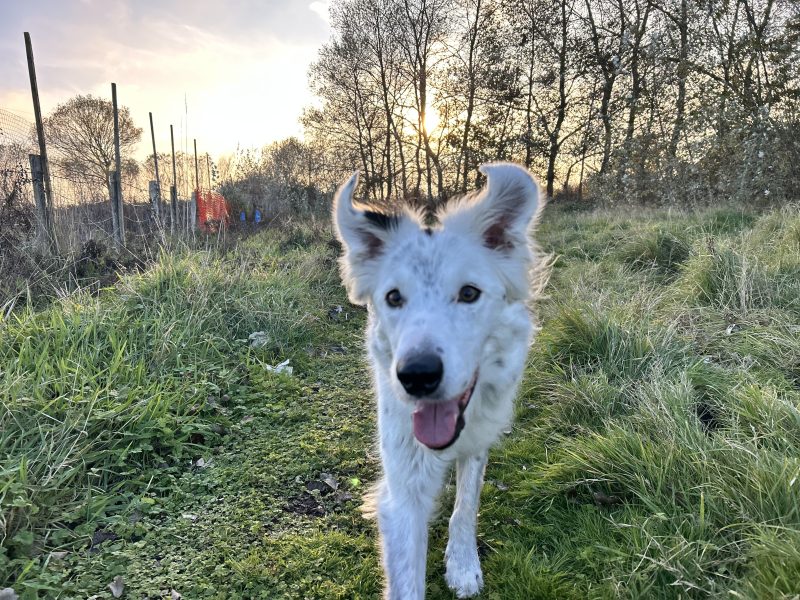
At home, your dog responds to their name, comes when you call and manages a few lovely steps beside you. You head out for a walk feeling reasonably confident, then discover that outside you appear to have become background noise.
There is a hedge to investigate, a dog across the road and something on the pavement that apparently requires a full forensic examination. Meanwhile, you are standing there with the treats, wondering what happened to the dog you had in the kitchen.
If this sounds familiar, it helps to look at what has changed. Your dog is now trying to use those skills somewhere with far more going on. They may need an easier starting point, more practice in different places or help feeling comfortable enough to respond.
The kitchen and the park are different learning environments
Home is familiar. Outside brings movement, smells, sounds and things your dog wants to investigate. A cue that works well in a quiet room may need further teaching in those surroundings.
We can help by practising in small steps between the two. That might mean moving from the kitchen to another room, then a quiet enclosed garden, before trying a suitable outdoor space. A busy park on a Saturday morning is a considerable jump from the back door.
When the surroundings become harder, make the exercise easier. Reward a brief response close to you before expecting the same duration or distance you have built at home.
Give them a chance to arrive
Think about walking into an unfamiliar place while someone immediately starts asking you questions. You may want a moment to look around first.
Where it is safe, give your dog time to investigate before asking for training. Sniffing and looking around can be part of settling into a new space. Keep them safely managed and choose somewhere with enough room for both of you.
Your dog does not need to spend the whole walk looking at your face. We want them to be able to explore and reconnect with us, with opportunities for both.
Begin with one small check-in
Choose a quiet spot and have some rewards your dog enjoys ready. While they are safely on lead, wait for a moment when they voluntarily turn their attention towards you. Acknowledge it with your familiar reward word, if you use one, and offer a treat.
Then let them look around again. You are making a small moment of connection worthwhile, without immediately asking for a sit, a wait and a perfectly choreographed turn.
Keep the practice brief. A few comfortable moments together give you something to build on. If you are repeatedly trying to attract their attention, move further from distractions or try somewhere easier.
Make the next step manageable
Once your dog can reconnect comfortably, try a tiny piece of something familiar: perhaps a couple of steps together or a short recall in a secure area. Reward that effort and give them a break.
You can gradually practise with more happening around you. Change one part of the challenge at a time where possible. Asking for a longer response, further away, beside a passing dog is quite a lot of changes in one go.
For recall practice where your dog could run off, use an appropriate lead or long line attached to a well-fitting harness, with enough clear space to handle it safely. Freedom needs to match the surroundings and the skills your dog can currently manage.
Rewards help, and so does choosing the right setting
Bring something your dog actually enjoys. Their opinion matters here; the packet saying “irresistible” does not settle the argument.
However, better treats alone cannot make every situation suitable for learning. If your dog cannot reconnect, keep adding distance from what is drawing their attention or choose a quieter place. You do not have to remain beside the distraction until an exercise works.
If your dog seems worried, focus on helping them feel safe. A training goal can wait while you move away from something they find difficult.
What does progress look like?
Progress might be your dog looking back at you after a sniff, responding in a quiet place they previously found exciting, or managing a few comfortable steps before exploring again.
Those moments are worth noticing. We can miss them when we are measuring the whole walk against how our dog behaves at home.
Your dog is learning how to share their attention in a much bigger world. Give them achievable practice, reward the moments you want to build and leave room for being a dog along the way.
If pulling is part of the picture, our guide to why dogs pull on the lead and how to help explores comfortable walking, rewards and making room for sniffing.
Help with focus and everyday training in Romney Marsh
At SkellyWAGS, our Life Skills classes in Old Romney include practical learning around distractions. If your dog needs more space or you would prefer individual support, 1-1 training lets us adapt the session to you both.
Tell me a little about your dog and we can work out a suitable starting point together. You do not need to arrive with a dog who already has it all worked out. That would make the training part rather redundant.

Skellywags Dog Training will be hosting a series of talks over the coming months all centred at helping us humans Read more

‘Reactivity’ – We will explore what is meant by reactivity, is it an overused label to put on dogs? We Read more

We had the pleasure of hosting Kathy Hobson from Dogs First Aid -Sussex for a chat about some of the Read more

What are they and how do they work? Pattern Games, developed by Leslie McDevitt, are a series of structured exercises Read more